LAANC and airspace basics for drone shows
A plain-language primer on controlled airspace, LAANC, and how it relates to planning a drone show — and where authorization goes beyond what LAANC covers.
Updated June 20, 2026
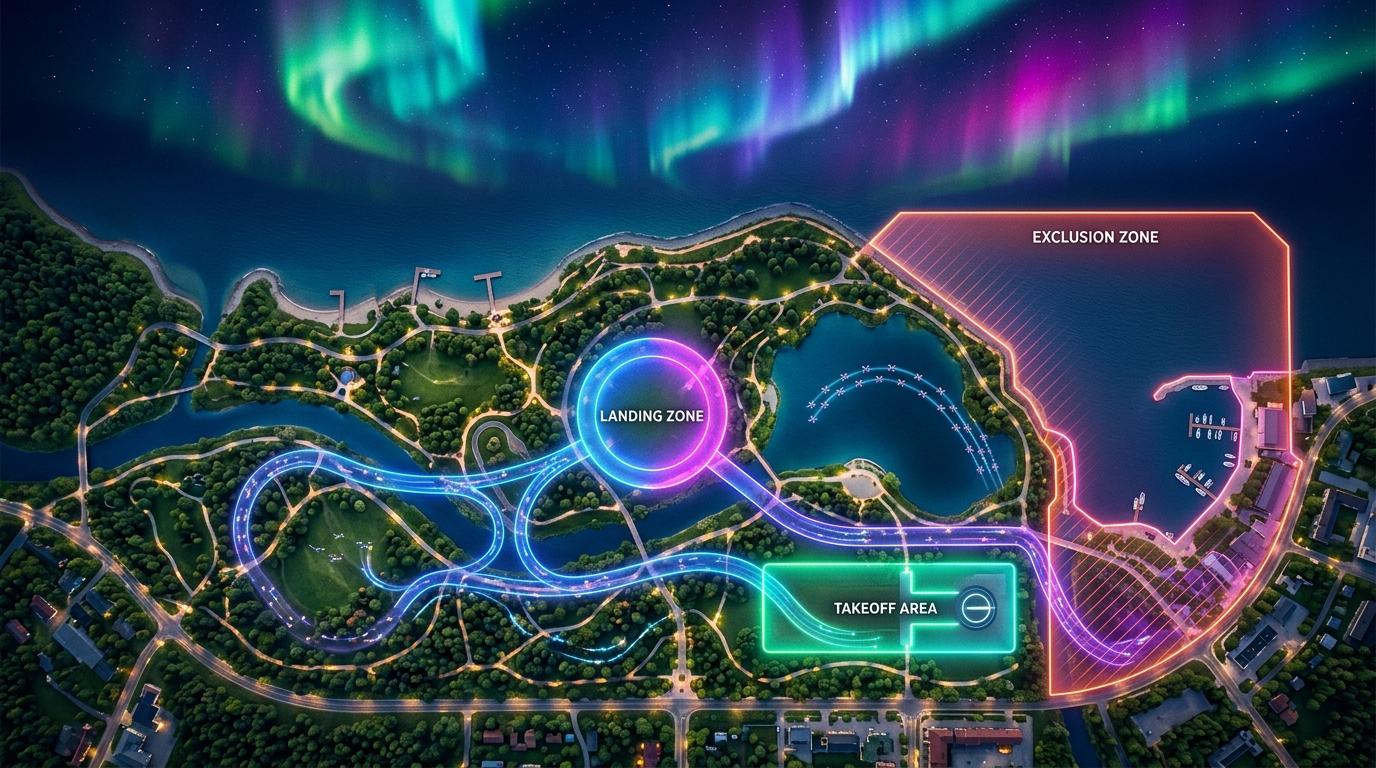
If you fly drones in the United States, you'll run into the word “LAANC” quickly. This primer explains what it is in plain language and how it fits into planning a drone show. It is educational only — it is not legal advice, and it is not a substitute for the FAA's official rules and guidance.
Controlled vs. uncontrolled airspace
Airspace in the U.S. is divided into classes. Near airports you'll find controlled airspace (commonly Classes B, C, D, and parts of E), while many rural and suburban areas are uncontrolled (Class G). The class matters because flying a drone in controlled airspace generally requires prior authorization, whereas uncontrolled airspace has different requirements.
What is LAANC?
LAANC stands for the Low Altitude Authorization and Notification Capability. It's a system, run jointly by the FAA and approved companies, that lets drone operators request authorization to fly in certain controlled airspace and, in many cases, receive a near-real-time response. Pilots typically access it through an approved app or service rather than directly.
- LAANC can provide authorization up to published altitude ceilings that vary by location (shown on UAS facility maps).
- It is designed for relatively routine requests. Operations that exceed the published parameters require a different, manual process.
- Receiving a LAANC authorization does not waive other rules you still have to follow.
Where drone shows go beyond LAANC
Drone-show productions frequently push past what routine LAANC requests cover. Common reasons include:
- Night operations. Most shows happen after dark, which carries its own requirements.
- Flying multiple aircraft. Coordinated swarms are a different category from a single drone and may require specific authorization.
- Flying over people. Audiences are often near or under the show footprint, which is heavily regulated.
- Higher altitudes or special locations. These can exceed published LAANC ceilings or fall outside its scope entirely.
For operations like these, operators commonly pursue waivers or other authorizations through the appropriate FAA process. The point is that “I got a LAANC authorization” rarely covers a full show on its own.
How a safety map helps you plan
Good planning starts with a clear picture of where you intend to fly. A show safety map lets you lay out takeoff and landing zones, flight paths, and exclusion areas, and view nearby airspace classes for context. Aurora's Show Safety Maps are built for exactly this — you can draw layered launch diagrams, overlay FAA airspace classes as an advisory aid, share the plan with clients and venues, and export it to PDF.
One thing to keep front of mind: those overlays are an advisory aid to help you plan and communicate. They are not an authorization and they don't replace the official process. The responsibility to obtain the right approvals and follow all applicable regulations stays with you as the operator.
A planning checklist
- Identify the airspace class over your proposed site.
- Determine which authorizations your operation actually requires.
- Map your launch, recovery, flight, and exclusion zones.
- Plan for night, over-people, and multi-aircraft considerations.
- Build in weather and reschedule contingencies.
- Confirm everything against current FAA guidance before you fly.
Plan your next show on Aurora
Build, contract, and broadcast — with safety maps and airspace context built in.